
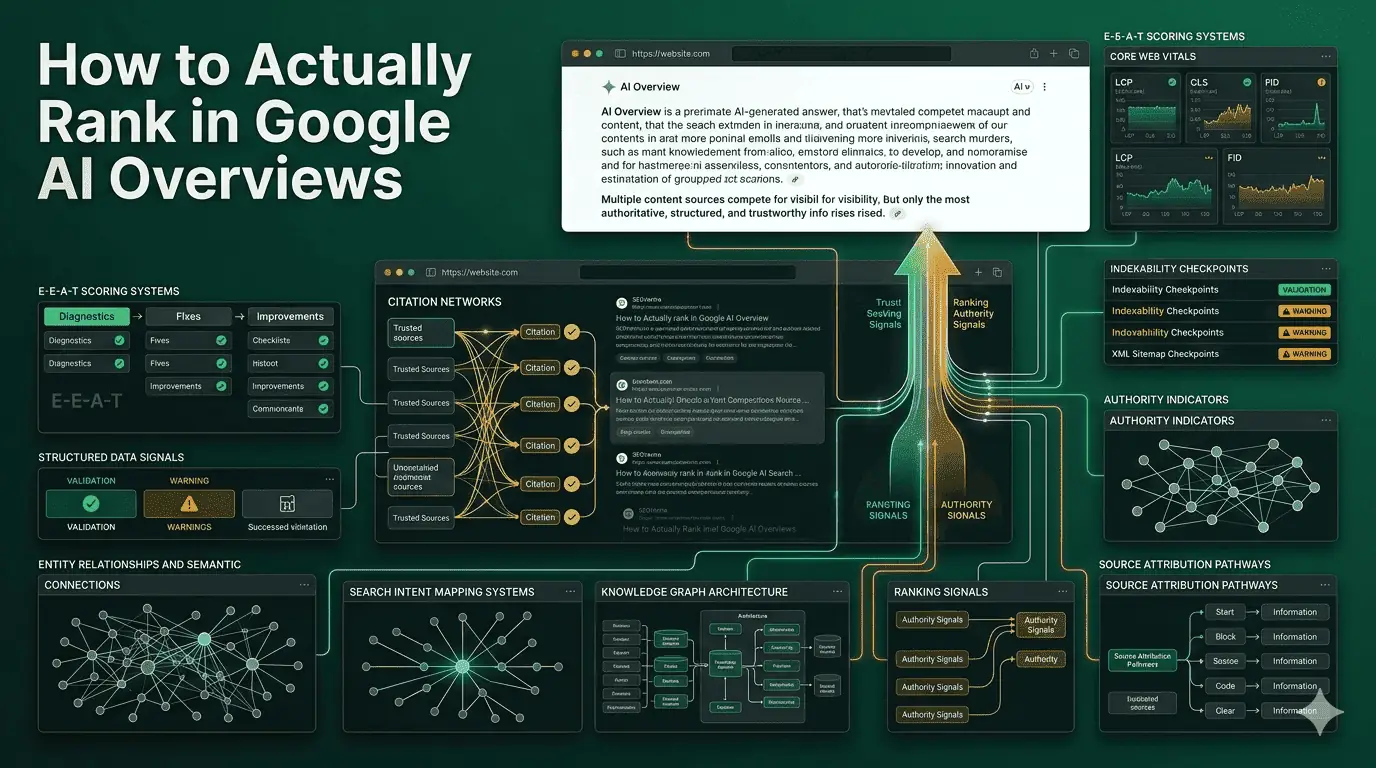
Google AI Overviews now appear on hundreds of millions of queries. They sit above organic results, synthesise answers from multiple sources, and cite some of them. If you're not being cited, you're being bypassed — even if you rank on page one.
What triggers an AI Overview?
AI Overviews are most common on informational queries — "how to", "what is", "why does", and comparative queries. You don't need to rank #1 to be cited. A page that ranks #7 but has excellent structured data and clear, direct answers can get cited over a #1 page with dense, paragraph-heavy content.
Being cited in an AI Overview drives a different traffic pattern: lower volume but higher intent. Users who click through from an AI Overview citation are typically further in their decision process.
Check your current AI citation probability
Before optimising, establish where you stand. The AI Visibility Checker scores your citation probability across Google AI alongside ChatGPT, Perplexity, and Gemini — with the per-signal breakdown that tells you exactly what to fix.
Citation probability score across ChatGPT, Perplexity, Gemini, Google AI, and Bing Copilot — with per-signal breakdown. Your starting point for AI Overviews optimisation.
The content signals that drive citation
Direct, specific answers near the top of the page
Google's AI system favours content that answers the query directly and early. Answer first, elaborate after. If your article buries the answer in paragraph eight, it's less likely to be cited than a page that states it clearly in the first 200 words.
Question-matching headings
AI Overviews often cite pages where the H2 or H3 heading closely matches the query. Review your heading structure against your target queries — the alignment is often worse than you think.
Analyze H1-H6 structure, heading hierarchy, keyword placement, and question-based optimization. Identifies exactly which headings need rephrasing for AI Overview citation.
Short, extractable answer blocks
Paragraphs of 2–4 sentences that answer a specific aspect of a topic are more extractable than dense long-form prose. Write for both the human reader and the AI synthesis layer simultaneously.
Schema markup specifically for AI Overviews
- →FAQPage schema — if your content answers common questions, this is the single highest-leverage schema type
- →HowTo schema — step-by-step content with HowTo markup is very frequently cited on how-to queries
- →Article with dateModified — freshness is a citation preference; outdated content gets deprioritised
- →Author schema — signals the content comes from a credible, identifiable person
Generate valid FAQPage, HowTo, and Article JSON-LD — the three schema types most directly linked to AI Overview citation. Free, no account.
Optimise your full article for AI citation
Optimize articles for ChatGPT, Perplexity, Gemini, and AI Overviews. Rewrite headings, generate FAQ schema, add direct-answer sections — with measurable citation improvement.
Co-founder and CEO of SEOVentra. Product, growth, and go-to-market. Writes about SEO strategy, AI search, and what it actually takes to rank and get cited by AI systems.