
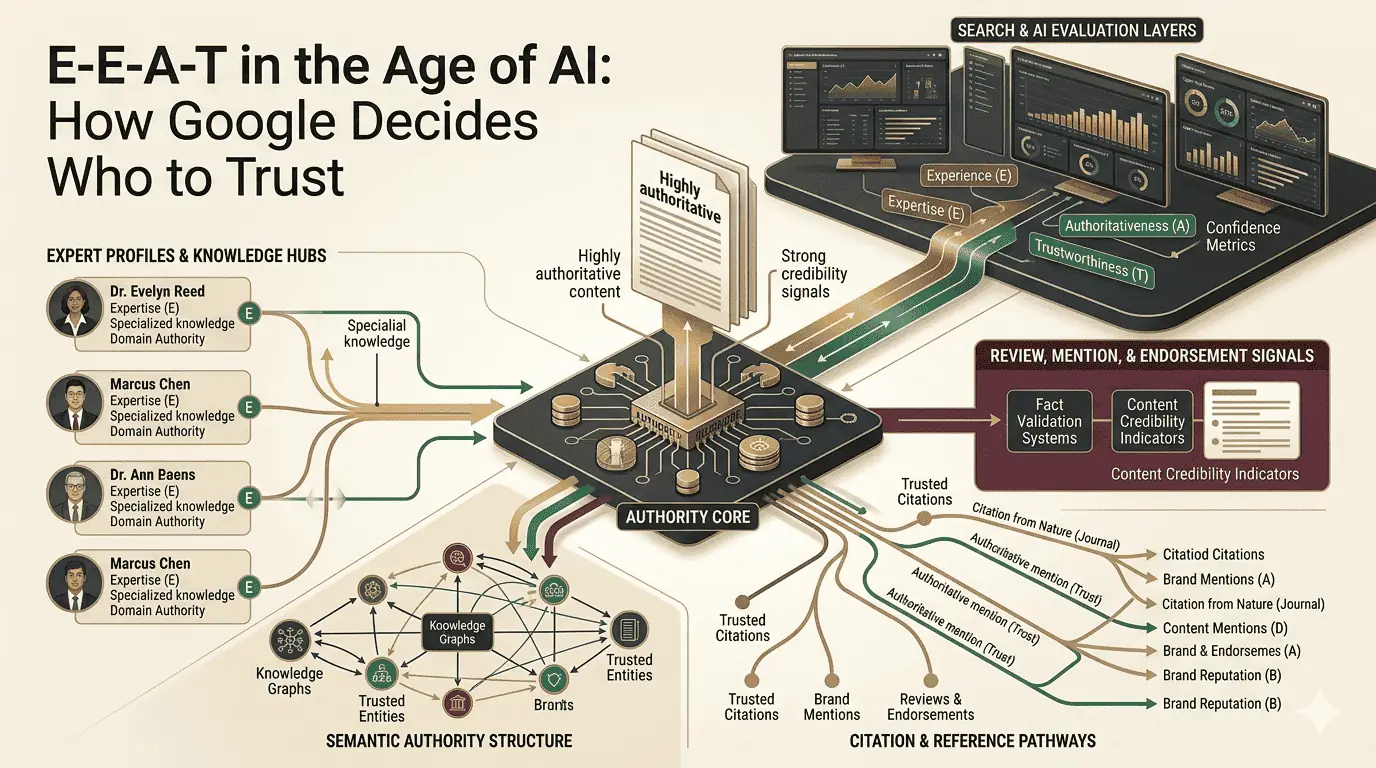
E-E-A-T — Experience, Expertise, Authoritativeness, and Trust — has been part of Google's Search Quality Evaluator Guidelines for years. With the rise of AI-generated content and LLM-powered answer engines, trust signals have become more important and more technically implementable than ever before.
What E-E-A-T actually means
- →Experience: first-hand experience with the topic — did the author actually do or use the thing they're writing about?
- →Expertise: formal or demonstrated knowledge — credentials, years of practice, depth of analysis
- →Authoritativeness: reputation and recognition in the field — who links to you, who cites you, who mentions your brand?
- →Trust: accuracy, transparency, and accountability — is the information correct? Is it clear who wrote it and why?
The "Experience" dimension was added in 2022. It matters because AI-generated content can appear expert without being grounded in experience. Google's systems are increasingly trying to identify that difference — and so are the AI answer engines that decide whether to cite you.
Check your meta and schema trust signals first
The technical foundation of E-E-A-T starts with what machines can read: your meta tags, schema markup, and structured author information. The Meta Analyzer shows you exactly what's present and what's missing.
Instantly see all meta tags, Open Graph data, Twitter Cards, and JSON-LD for any URL — with a scored health check. Check author schema, organisation markup, and trust signals in seconds.
Why AI systems care about E-E-A-T signals
When an AI answer engine assembles a response, it needs to decide which sources to trust. The criteria overlap heavily with E-E-A-T: Is the author credible? Is the site authoritative on this topic? Is the information verifiable and recent?
Sites with strong E-E-A-T signals tend to attract more high-quality backlinks, which strengthens authoritativeness, which attracts more AI citations, which drives more traffic — a virtuous cycle that compounds over time.
Generate schema for author and organisation trust
Generate valid JSON-LD for Article, Person, and Organisation schema — the technical implementation of E-E-A-T trust signals. Free, no account needed.
Check your AI citation probability
E-E-A-T improvements take time to compound — but you can measure their effect on your AI citation probability as you implement them.
Measure your citation probability across ChatGPT, Perplexity, Gemini, and Google AI. Track how E-E-A-T improvements affect your AI discoverability score over time.
E-E-A-T audit checklist
- →Does every article have a bylined author with a linked, schema-marked-up author page?
- →Does your author page include credentials, experience markers, and verifiable social presence?
- →Does your site have clear About, Contact, and Editorial Policy pages?
- →Is your Organization schema complete with real contact details and social profiles?
- →Does your content include original data, first-hand examples, or verifiable specific claims?
- →Is your content updated when information becomes outdated, with a visible dateModified?
Co-founder and CEO of SEOVentra. Product, growth, and go-to-market. Writes about SEO strategy, AI search, and what it actually takes to rank and get cited by AI systems.