
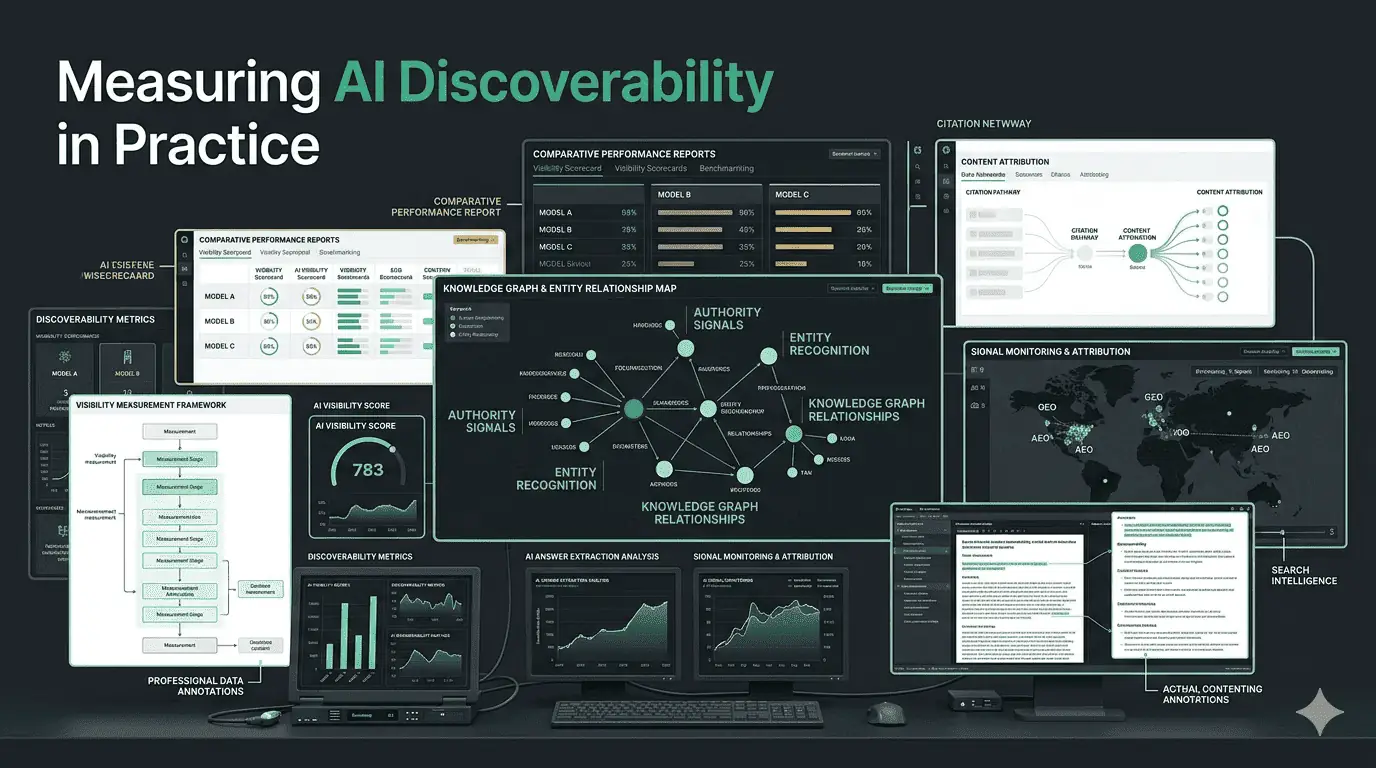
The hardest part of AI discoverability isn't implementation — it's measurement. Unlike traditional SEO where ranking position is a clear outcome metric, AI citation is diffuse, inconsistent, and difficult to attribute. Here's how we approach it at SEOVentra.
The measurement problem
AI engines don't expose citation data the way search engines expose ranking data. There's no equivalent of Google Search Console's performance report. Measurement requires a different approach: score the inputs (your content's structural signals), sample the outputs (manually query AI engines for your key topics), and track change over time in both dimensions.
Start with your AI Visibility Score
The fastest way to establish a baseline is running a visibility check across the AI engines that matter — ChatGPT, Perplexity, Gemini, Google AI, and Bing Copilot. You'll get a per-signal breakdown that tells you exactly which of the six dimensions is dragging your score down.
Citation probability score across ChatGPT, Perplexity, Gemini, Google AI, and Bing Copilot — with per-signal breakdown. See exactly why AI engines aren't citing you.
The six AI visibility dimensions
| Dimension | Weight | Key signals |
|---|---|---|
| LLM Readability | 20% | Sentence length, structure clarity, absence of keyword stuffing |
| Content Structure | 18% | Heading hierarchy, paragraph length, scannable organisation |
| Schema Coverage | 17% | FAQPage, Article, Author, BreadcrumbList markup |
| FAQ Presence | 15% | Question-format headings, direct answer paragraphs |
| Content Freshness | 15% | dateModified, publication recency, temporal specificity |
| Entity Clarity | 15% | Named entities, defined terms, relationship clarity |
Fix what the score surfaces
The AI Content Optimizer takes your score and tells you specifically what to rewrite — which headings need rephrasing, where to add FAQ schema, which sentences are too dense for LLM extraction.
Optimize articles for ChatGPT, Perplexity, Gemini, and AI Overviews. Rewrite headings, generate FAQ schema, add direct-answer sections. Increase AI citation probability measurably.
Sampling AI citation manually
- 01Identify the top 20 queries where you expect to appear based on content
- 02Query ChatGPT, Perplexity, and Google AI Mode weekly for each query
- 03Record citation presence/absence and excerpt quality in a structured log
- 04Correlate citation outcomes with AI Visibility Score improvements
- 05Track which schema implementations drove the largest citation increases
AI answers vary by session, query phrasing, and user context. Manual sampling captures a directional signal, not a precise measurement. Treat citation rate as an ordinal metric — improving, stable, or declining.
Also check: heading structure
One of the most common issues we see tanking AI visibility scores is poor heading structure. H2s that aren't question-based, missing H3 hierarchy, and heading keyword mismatches all damage extractability.
Analyze H1-H6 structure, heading hierarchy, keyword placement, readability, and question-based optimization for SEO and AI search.
Co-founder and CEO of SEOVentra. Product, growth, and go-to-market. Writes about SEO strategy, AI search, and what it actually takes to rank and get cited by AI systems.