
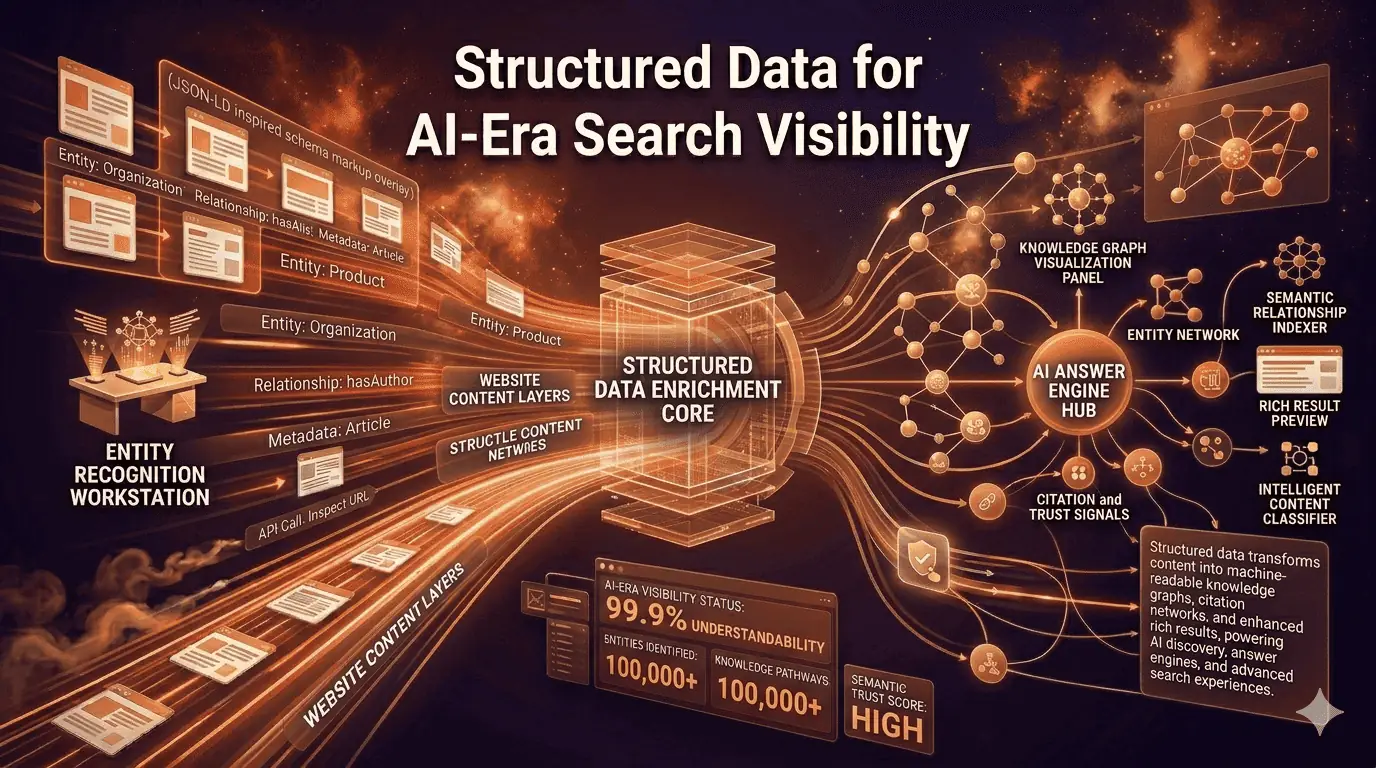
Structured data was designed for search engine parsers — but it turns out that the clarity required for machine-readable schema is exactly what makes content more accessible to large language models. The two goals are more aligned than most teams realise.
Why schema matters more now
Traditional schema markup (JSON-LD, Microdata) helps search engines understand entity relationships, content type, and authorship. But AI systems parsing your content for answer generation benefit from the same signals — they provide explicit semantic metadata that reduces ambiguity.
When we built SEOVentra's AI scoring model, schema coverage was one of the strongest predictors of citation likelihood. Sites with comprehensive FAQPage and Article schema were consistently being cited by Perplexity and Google AI Mode even when their traditional rankings were modest.
Generate the right schema instantly
The fastest way to start is generating valid JSON-LD for your page type. Don't hand-write it — the spec is finicky and errors are silent.
Generate valid JSON-LD for FAQPage, Article, Product, and LocalBusiness — the highest-impact fix for AI citation probability. Free, no account needed.
Priority schema types for AI visibility
FAQPage
FAQPage schema is arguably the highest-leverage implementation for AI search visibility. Answer engines are explicitly designed to surface direct answers to user questions — and FAQPage schema hands them exactly that structure.
{
  "@context": "https://schema.org",
  "@type": "FAQPage",
  "mainEntity": [
    {
      "@type": "Question",
      "name": "What is IndexNow and how does it work?",
      "acceptedAnswer": {
        "@type": "Answer",
        "text": "IndexNow is an open protocol that allows website owners to notify search engines when content is created, updated, or deleted — prompting immediate crawl prioritisation rather than waiting for scheduled discovery."
      }
    }
  ]
}
Article and Author
Article schema with Author and Person markup directly addresses E-E-A-T signals. AI systems use author identity as a trust proxy when deciding whether to cite content.
BreadcrumbList
Breadcrumb schema helps AI systems understand your site structure and content hierarchy — context that influences how content is grouped and cited in AI responses.
Validate your existing schema
Already have schema on your pages? It's worth checking what's actually being parsed versus what you think you've implemented. The Meta Analyzer shows all JSON-LD on any URL in seconds.
Paste any URL to instantly see all meta tags, Open Graph data, Twitter Cards, and JSON-LD — with a scored health check. Free, no login.
Common implementation mistakes
- →Schema markup that contradicts visible page content — Google and AI systems penalise discrepancies
- →Missing @id properties on Organisation and Person — prevents entity disambiguation across pages
- →FAQPage schema added to pages where questions aren't actually visible to users
- →Nested schema errors — always validate with Google's Rich Results Test before deploying
- →Outdated dateModified values — freshness signals matter for AI citation preference
Co-founder and CEO of SEOVentra. Product, growth, and go-to-market. Writes about SEO strategy, AI search, and what it actually takes to rank and get cited by AI systems.