
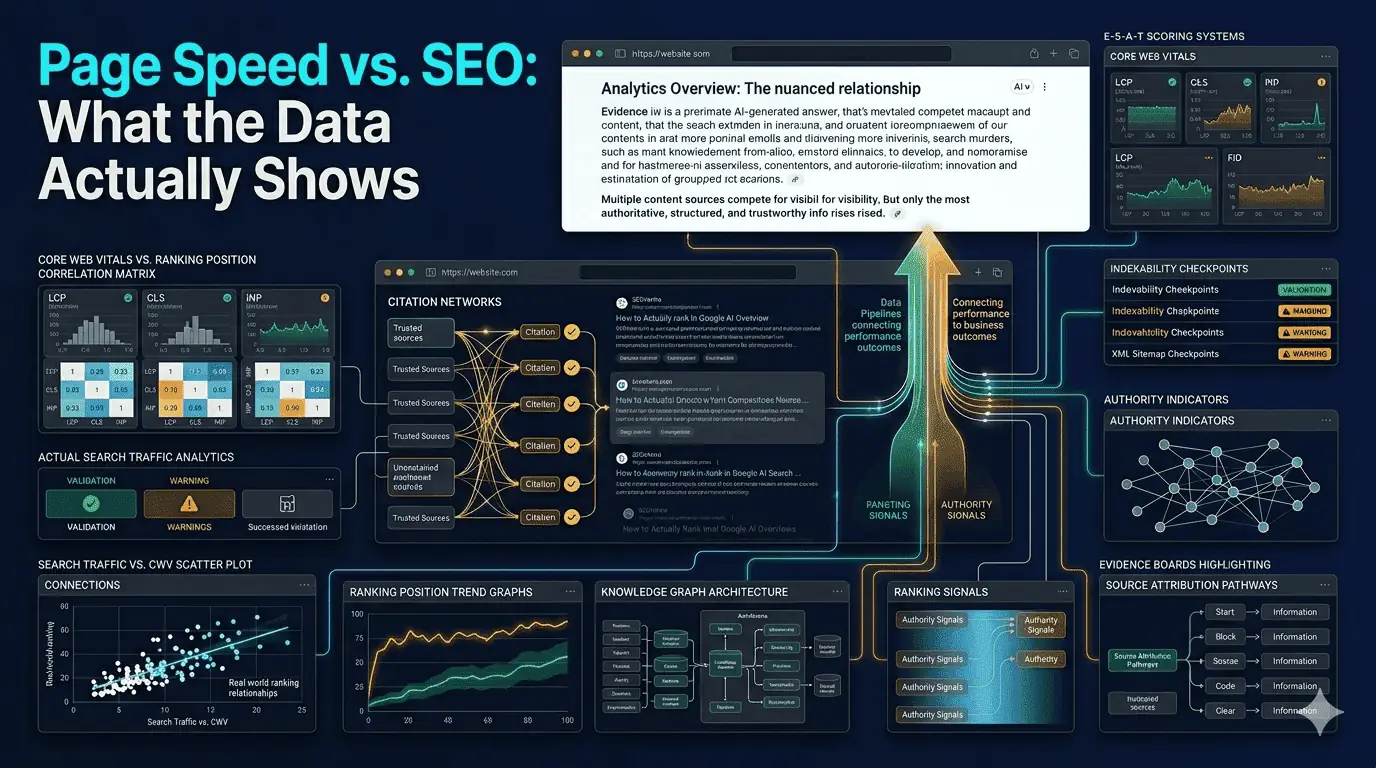
Page speed has been a Google ranking factor since 2010, and Core Web Vitals joined the Page Experience signals in 2021. But the relationship between raw speed numbers and ranking positions is often misunderstood — and the misunderstanding leads teams to optimise the wrong things.
Measure your real performance before optimising
Before spending engineering time on speed, measure your actual CrUX field data — not a Lighthouse lab score. The two can differ dramatically. Mobile users on mid-range devices on 4G connections see a very different page than a DevTools simulation suggests.
Analyze real Core Web Vitals with CrUX field data alongside lab metrics and actionable recommendations. Uses actual user measurements, not synthetic tests.
Speed as a threshold signal, not a gradient
The most important thing to understand: Google applies speed as a threshold-based signal, not a linear gradient. There's no evidence that 0.8s ranks better than 1.2s if both are comfortably "Good". The ranking impact is concentrated at threshold crossings: Poor → Needs Improvement, and Needs Improvement → Good.
Speed optimisation has two kinds of ROI: ranking ROI (concentrated at threshold crossings) and conversion ROI (more linear — faster is generally better for conversions). Don't conflate them. Do the analysis separately.
The mobile vs. desktop gap
Google indexes and ranks the mobile version of your site. A performance problem that only shows up on mobile is a real ranking problem, even if your desktop score looks great. The CrUX API segments field data by device — your mobile LCP, INP, and CLS are what actually matter for ranking.
The hidden cost of third-party scripts
- →Audit your third-party scripts — every one should have a documented business reason for being on your site
- →Load non-critical scripts asynchronously and defer them past the first interaction window
- →Consent management platforms (CMPs) are a common INP killer — test yours specifically under load
- →Analytics platforms, heatmap tools, chatbots, and A/B testing frameworks each add main-thread weight
- →Use Chrome DevTools Performance panel to identify which scripts are scheduling long tasks
Check how crawlers see your page performance
See which resources Googlebot is loading and evaluating on your pages — including the third-party scripts and render-blocking elements affecting your Core Web Vitals.
Speed and conversions: the stronger case
For sites already in the "Good" range for Core Web Vitals, the conversion case for further speed investment is often stronger than the ranking case. A 100ms improvement in response time has documented effects on bounce rate and checkout completion. Frame your speed work accordingly: threshold crossings are ranking work; sub-threshold improvements are product work with different success criteria.
Co-founder and CEO of SEOVentra. Product, growth, and go-to-market. Writes about SEO strategy, AI search, and what it actually takes to rank and get cited by AI systems.