
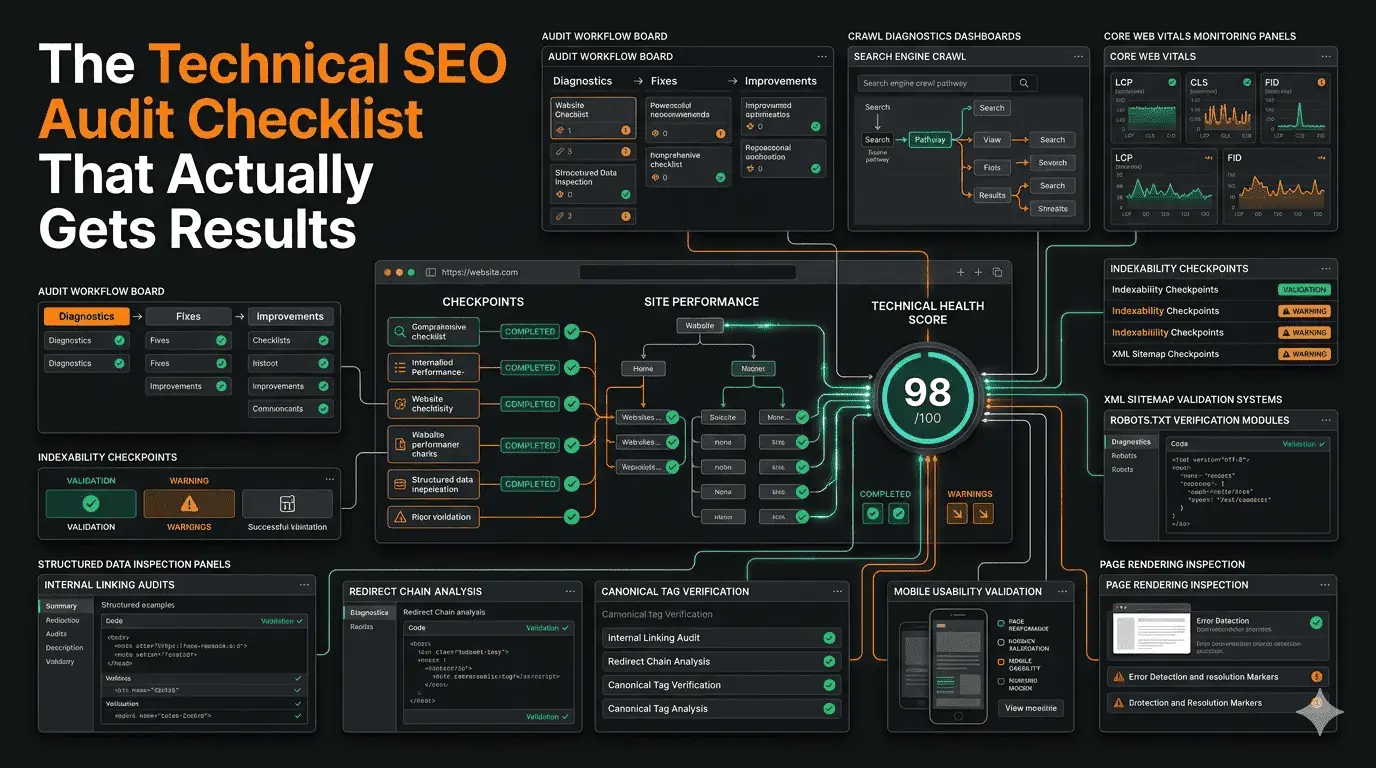
A technical SEO audit is only useful if it tells you what to fix first. Most audit tools hand you a list of 200 issues without telling you which three actually matter. This checklist is ordered by the things that break rankings the most severely.
Before you start: establish your baseline
Before touching anything, snapshot where you are. Export your GSC Performance report, your Coverage report, your Core Web Vitals report, and your current crawl stats. Without these before-states you can't prove what worked.
Establish your AI discoverability baseline before you start — so you can measure improvement in both traditional and AI search as your fixes land.
Tier 1: issues that break indexing outright
- 01robots.txt blocking key pages or entire directories — verify with GSC URL Inspection on your most important URLs
- 02noindex tags on pages that should be indexed — common after CMS migrations and staging-to-production pushes
- 03Canonical tags pointing to the wrong URL — self-canonicals that accidentally canonicalise to 404s or redirects
- 04Soft 404s returning HTTP 200 — pages that say "not found" in the UI but return a 200 status code
- 05Critical pages returning 5xx errors — these drop out of the index fast when errors persist
- 06Redirect loops or chains longer than 3 hops — Googlebot stops following chains
Validate every robots.txt directive and audit AI bot access. Catches Tier 1 blocking mistakes instantly — free, no login.
Detect canonical chain errors, self-referential loops, and missing rel=canonical tags. Fixes the most common Tier 1 indexing blockers.
Tier 2: issues that dilute crawl and PageRank
- →Duplicate content without canonical consolidation
- →Paginated archives with no crawl depth limit
- →Parameter URLs creating content explosions
- →Orphaned pages with no inbound internal links
- →Sitemap includes redirects, noindex pages, or 4xx URLs
See your full crawl graph — which pages Googlebot can reach, which are orphaned, and which paths are wasting crawl budget.
Tier 3: structured data and E-E-A-T signals
- →No Article or BlogPosting schema on content pages
- →FAQPage schema missing on pages with question-format headings
- →Missing Author schema or author pages with no markup
- →dateModified not updated when content is refreshed
- →Organisation schema absent or incomplete
Generate valid JSON-LD for all Tier 3 schema types — FAQPage, Article, Author, Organisation. Free, no account needed.
See exactly what schema and meta is present on any URL right now. Essential for verifying Tier 3 fixes are actually live.
Tier 4: Core Web Vitals
| Metric | Good threshold | Most common cause of failure |
|---|---|---|
| LCP | < 2.5s | Unpreloaded hero image, slow TTFB, render-blocking scripts |
| INP | < 200ms | Long main-thread tasks from third-party scripts |
| CLS | < 0.1 | Images without dimensions, late-loading ad slots, font swaps |
Analyze Core Web Vitals with CrUX field data and actionable recommendations. Identifies exactly which Tier 4 issue to fix first.
Run the full checklist automatically
Generate a complete, actionable SEO checklist covering all four tiers — technical, on-page, content, and off-page. Customised to your site.
Co-founder and CTO of SEOVentra. Builds the indexing pipelines, audit engine, and AI visibility infrastructure. Former backend engineer obsessed with making search work at scale.