
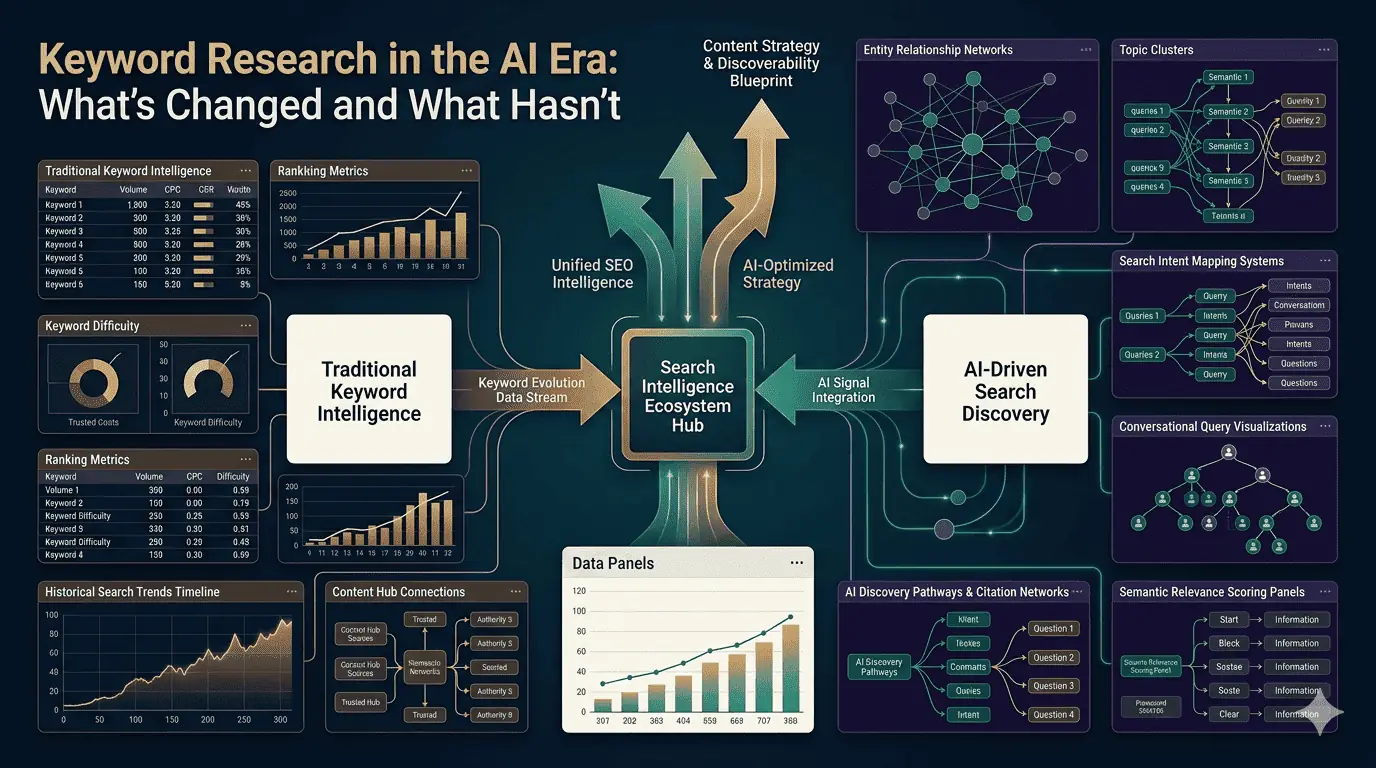
Keyword research used to be mechanical: find the words people search, estimate volume, rank for them. AI-powered search has complicated this in two directions — making some keyword-level thinking less important, and making intent-level thinking more important than ever.
Start with keyword discovery
Before applying AI-era frameworks, you still need to know which keywords exist in your space and what intent they carry. The Blog Keyword Generator is a good starting point for content teams — it builds topic clusters, not just keyword lists.
Generate blog keyword ideas, long-tail variations, topical clusters, and content opportunities to improve organic search visibility. Built for content teams planning around topics, not just terms.
What's become less important
Exact-match keyword density
Optimising for exact-match keyword frequency has been declining in importance for years — AI-era search has accelerated this. Modern search systems understand semantic equivalence. Writing naturally and covering a topic comprehensively works better than stuffing a specific phrase.
Volume as the primary selection criterion
High-volume keywords are typically dominated by high-authority domains. But in AI-powered search, a well-structured page answering a specific question precisely can get cited in AI Overviews and AI chat responses regardless of whether it ranks #1 traditionally. Long-tail, specific questions often punch above their volume weight in AI search.
What's become more important
Search intent clarity
AI search systems are excellent at matching content to intent. If your page's intent doesn't clearly match what a searcher wants, it won't be cited — even if it contains the right keywords. The upfront intent analysis matters more now: is this informational, a comparison, a how-to, or commercial research?
Question-based keyword mapping
AI search particularly surfaces content that directly answers questions. Build your keyword research around questions — not just topics — and map specific questions to specific content sections.
Check keyword density without overstuffing
Once you've written content, check that keyword usage is natural — prominent enough to rank but not so concentrated that it triggers stuffing signals.
Measure keyword frequency, density, prominence, and distribution across your content to prevent under-optimization or accidental stuffing.
Discover what you're already ranking for
One of the most underused keyword research inputs is your own GSC data — queries you're appearing for but not fully answering. The Keyword Research tool surfaces these opportunities directly.
Discover keyword opportunities, search intent patterns, and topic clusters for SEO growth — including gaps in your existing content coverage.
Move your keyword research output from "a list of keywords to rank for" to "a topic map of questions to answer". The former optimises for a specific algorithm state. The latter works across traditional search, AI Overviews, AI chat, and whatever search looks like in three years.
Check your headings match keyword intent
Analyze heading structure, keyword placement, and question-based optimization. Verify your H2s match the search intent of your target keywords.
Co-founder and CEO of SEOVentra. Product, growth, and go-to-market. Writes about SEO strategy, AI search, and what it actually takes to rank and get cited by AI systems.