
Site architecture is one of those things that's easy to get wrong quietly — the problems don't show up as dramatic traffic drops, they show up as a persistent ceiling on how well your content performs.
Start by seeing how crawlers read your structure
Architecture problems are invisible in a browser. You need to see your site the way Googlebot does — which paths it follows, which it can't reach, and how it interprets your link hierarchy.
See your pages the way search engine crawlers do — analyzing crawlability, rendering, directives, links, and indexation signals. Reveals architecture problems invisible to human browsers.
The flat hierarchy principle
The closer a page is to your homepage in terms of clicks required to reach it, the more link equity it receives and the more likely it is to be crawled frequently. The goal: important pages reachable in 3 clicks or fewer from the homepage.
A URL can be short (domain.com/blog/post) but still be deep in terms of clicks if it's not linked from anywhere prominent. Click depth matters more to search engines than URL path length.
Clean up your URL slugs
URL structure is part of your architecture signal. Messy, keyword-free slugs dilute the topical signals your site sends. Generate clean slugs before you publish — not after, when URL changes become expensive.
Generate clean, SEO-friendly URL slugs from titles, keywords, products, categories, and blog posts. Get it right before publishing — changing URLs later costs link equity.
Topic clusters and pillar pages
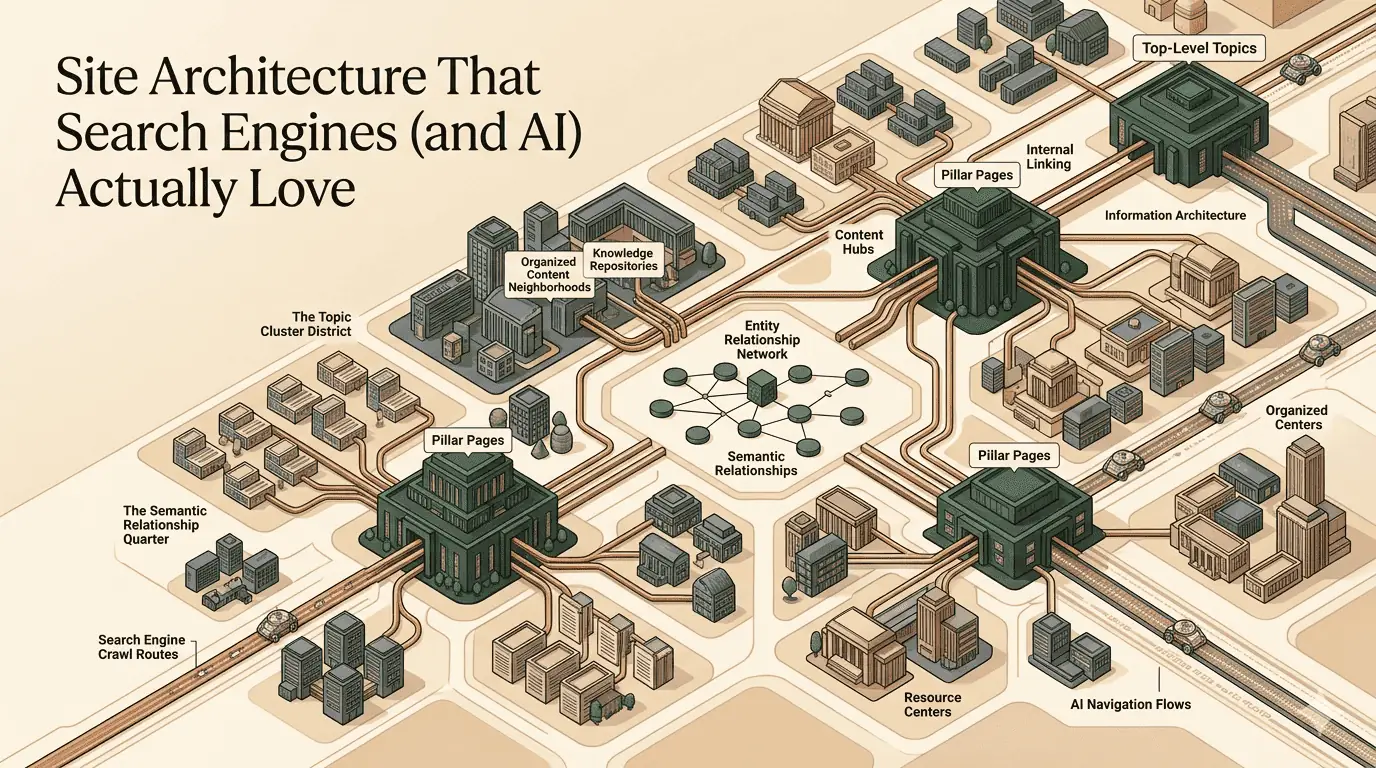
The pillar-cluster model is the standard approach for building topic authority. A pillar page covers a broad topic comprehensively; cluster pages go deep on specific subtopics — and all cluster pages link back to the pillar. This creates a clear topic hierarchy that both search engines and AI systems recognise.
Check canonical implementation across your architecture
Architecture changes often create canonical issues — pages that should self-reference but are pointing to outdated URLs, or pagination pages canonicalising incorrectly. Run a canonical check after any structural change.
Detect canonical chain errors, self-referential loops, cross-domain conflicts, and missing rel=canonical tags. Essential after any site restructure.
How architecture signals feed AI understanding
AI systems don't just read individual pages — they build a model of your site's topic coverage based on how content is structured and interlinked. A well-architected site with clear topic clusters gives AI systems a more coherent picture of your expertise than scattered, unlinked content on similar topics.
Review click depth for your 50 most important pages. Check that every page is linked from at least 2 other pages. Verify breadcrumb schema reflects your actual topic hierarchy. Look for orphaned pages. Confirm canonical tags are correct on unique pages.
Co-founder and CTO of SEOVentra. Builds the indexing pipelines, audit engine, and AI visibility infrastructure. Former backend engineer obsessed with making search work at scale.